Creating the world and stories of Dungeon Realms was a wonderful challenge for many reasons. The goal was to create an original world that would provide players with what they might expect from games like D&D and stories that would showcase the best Dungeon Realms had to offer.
WORLDBUILDING
The campaign setting that became the Charred Shores is one of my greatest creative achievements. I was given the task to create a world that could house all of the content provided by the open D&D license and work on a digital platform. Something massive, fun, magical and believable.
I created the world working backwards. I knew what the vision of the product was (described in the Creative Direction section), and I knew I had to create smaller locations with very specific requirements that are linked together. To make everything work I started from scratch, drafting the creation myth of the world and mapping the entire planet it was set on. Since I roughly knew what kind and level of technology, culture, and worship the world’s regions needed to have, I had to root them all in ancient times. If we needed to have one region with a realistic European medieval aesthetic, one with grimdark vibes and one with Tolkien-esque qualities, they all had to believably share the same history. I also knew what kinds of monsters and playable races we’d use and they all had to have their place in the world.
In addition, one of my primary goals was to provide narratives everywhere. Dungeon Realms’ gameplay was limited compared to table top, so giving GMs access to premade stories as often as possible was important. I adopted a sort of “fractal” design to worldbuilding, where every piece of content shared similar characteristics. Everything had history, descriptions, and a current situation that needed solving. Adventures, story hooks, fun descriptions hinting at the lore, a universal pantheon of gods – everything had to be interconnected and easy to jump into.
I spent months synthesizing all of this info into a coherent structure together with the fabulous Mar von Zellen, the lead writer. We created a massive world and decided to start with two regions, Cradle Island and Fairfax. These two regions were delivered in 2022 in a very detailed guide together with a short guide to the entire campaign setting. The rest of the world sadly remains unreleased, but hopefully will see the light of day in the future.


NARRATIVE DESIGN
I already had experience with narrative design when I joined the team, but Dungeon Realms completely changed my view of it. I was used to designing with tools like Twine and Yarnspinner or on paper as a GM. The adventures created for Dungeon Realms forced me to relearn everything, because it exists somewhere between table top and video games.
Designing a tabletop adventure for the app didn’t work, because the structure was way too open and reliant on the GM. A section of a story that takes a minute at a table can take hours when played by post, so simply telling a GM “let the party investigate the room” meant potentially ruining the entire game for them. How long should they investigate? Should every player get to do their own investigation check? What can they find? Something very simple turns into hours of tediously exchanging messages without progressing the story at all. The feeling of playing an RPG vanishes.
Tools for video games were also not very helpful. A player is always on rails in a video game, so designing a branching storyline is fairly straight forward, although very difficult. A player in Dungeon Realms can always decide to do anything the rules allow, potentially completely derailing a story. Giving the GM a story on rails was never an option.
I had to really break down how narrative design works. I spent months researching, reading books and watching GDC talks in hopes of finding some guidance. I failed multiple times, creating stories that were way to massive or too “video game-y”. I slowly pieced together what to do until a structure emerged.
I started using what I called “situations” as the main element. Every situation is a problem the players face set in a location and to complete it they must reach a minimum exit condition. How the condition is reached is not important – it simply must be met to progress. Every situation has clear boundaries the players can’t breach and triggers that activate specific events.
The system is a bit confusing to fully describe, so I will give an example instead. In an adventure called Frozen Hunger, the adventuring party reaches a hunting lodge in the middle of a blizzard while escorting a merchant. The situation is set. The party can’t leave because of the deadly blizzard and the merchant wanting to rest. There are several NPCs they can interact with and they can explore the cabin. What the players do is up to them – they are not limited in how they express themselves and interact with the world. There are several triggers set in case they decide to do something specific, however, like NPC dialogue prompts. The minimum exit condition in this case is simple: the players introduce their characters and talk to the bartender. After that, the GM can activate the next story beat at any point, giving them full control over the flow of the game. This way the players feel like they are in control, freely interacting with the game and role-playing, but the story is still very much set in motion, not reliant on their actions. The next story beat is the merchant getting attacked and abducted, which creates a new situation.
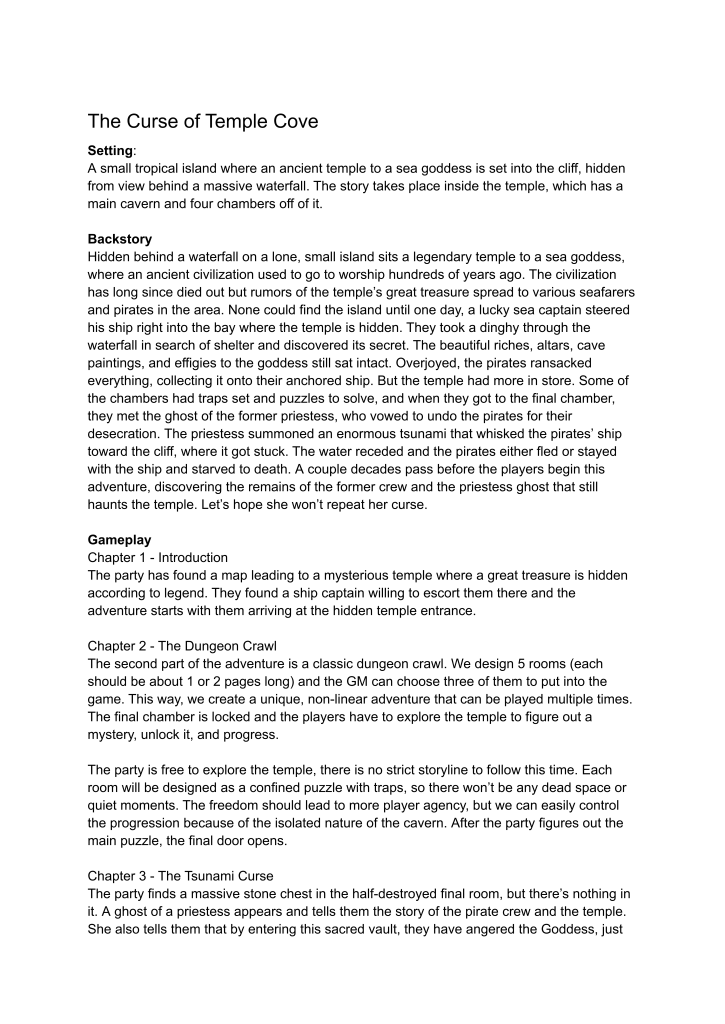
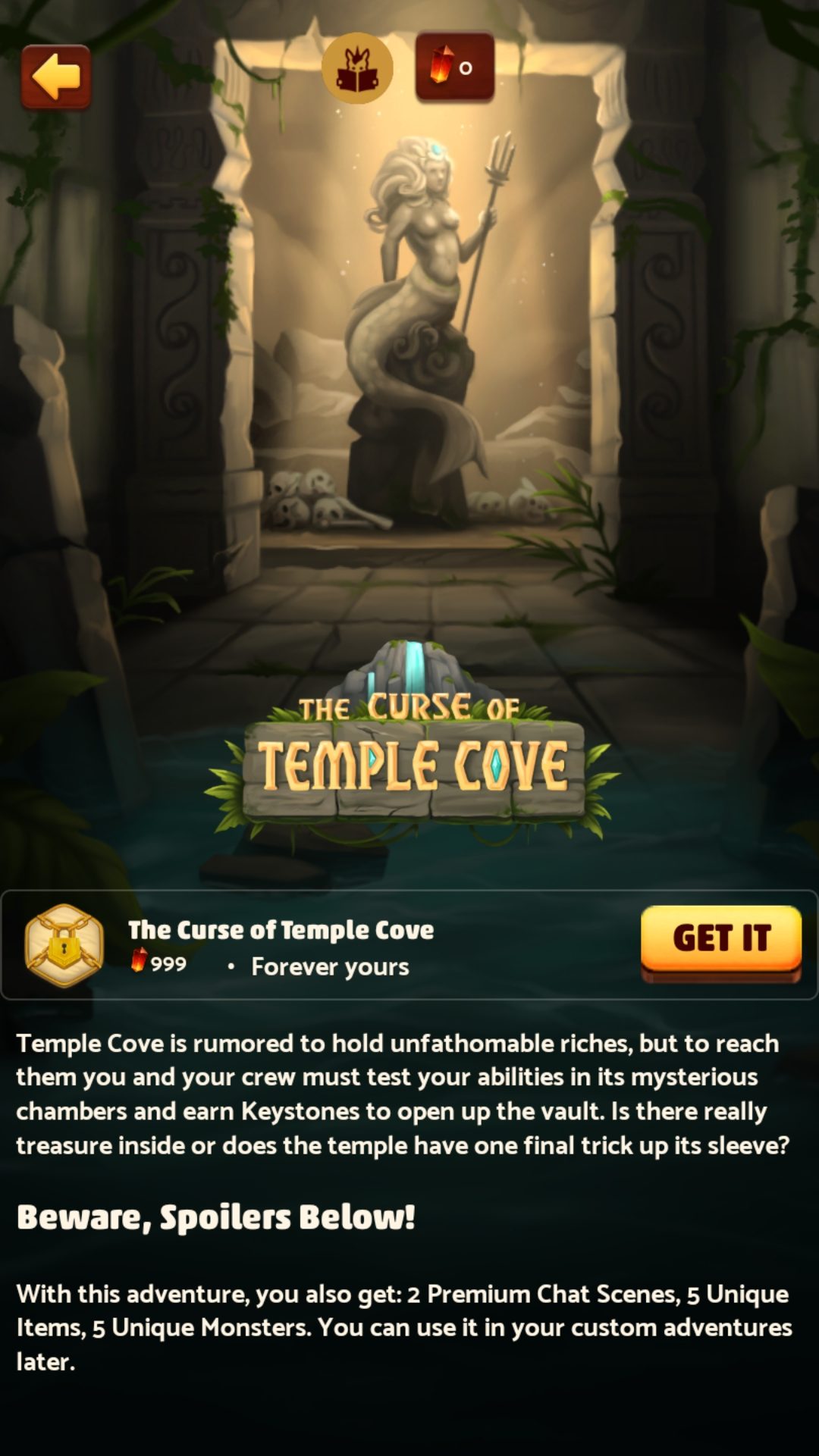
We created 6 adventures using this structure culminating in well over 200 pages of interactive fiction with incredible illustrations integrated into the app’s gameplay. We got lots of constructive feedback which lead into many improvements and overwhelmingly positive reactions. I can confidently say this experience made me a very well-rounded narrative designer with a deep understanding of how interactive narrative works. Now I’m able to transfer these skills to almost any other interactive medium, be it tabletop or video games, because I had to learn so much working on my beloved stories full of enchanted goats, pirate skeletons, and bloodthirsty undead.
 TOM GESTINGER